Showing posts with label hackerspacekl. Show all posts
Showing posts with label hackerspacekl. Show all posts
Thursday, December 15, 2011
Hackerspacekl Meeting 2011
Hackerspacekl will have a meeting to decide on the future direction of our hackerspace. Detail of the meeting can be found in

Monday, October 24, 2011
My Post On Robots Making
I have started a series of post on making robots with arduino at hackerspacekl website. You can find out more on the links :
http://www.hackerspace.my/2011/10/24/making-a-robot-with-arduino-part-1-intro-to-motor-controller/trackback
http://www.hackerspace.my/2011/10/24/making-a-robot-with-arduino-part-1-intro-to-motor-controller/trackback
Monday, May 09, 2011
The Great Global Hackerspace Challenge
Not long ago, Me and the Hackerspacekl gang, join The Global Hackerspace Challenge. Basically we build a Arduino Shield that process words.
Actually the whole process is best viewed on the hackerspacekl blog.
http://www.hackerspace.my/category/projects/the-story-box
In summary, here is what we learned.
- K.I.S.S, Keep It Small and Simple
The Atmega168 have only 16KiB of memory which the code itself taken half of it. and it is slow, it runs on such a speed 16 MHz. Modern computer is around 2 GHz. It better be simple, because debugging is hard.
- Serial is your best friend (on arduino anyway)
Unlike programming on PC or Web app. There is no print function to be used to debug, there is no debugger either. Even we have a LCD, it is not reliable. And serial pretty much built into the arduino board. So USE IT.
- Optimization matters
On dynamic language like python, or more modern language like java. There is garbage collector, even c/c++ have OS to help on that. So one don't need to worry about memory issues. But on arduino, removing unused code and code, and save a lot of memory.
- One need to think very low level.
The I2C to eeprom code is about shifting bits/bytes to write to the EEPROM. For once we are thinking in bytes. And we need to know a bit of hardware, to write the code properly.
Overall, it is fun and a interesting experience. For a programmer that spend time on python, or doing web development. Opening one eyes to embedded programming a bit, a little bit of experience that meant a lot to me.
Actually the whole process is best viewed on the hackerspacekl blog.
http://www.hackerspace.my/category/projects/the-story-box
In summary, here is what we learned.
- K.I.S.S, Keep It Small and Simple
The Atmega168 have only 16KiB of memory which the code itself taken half of it. and it is slow, it runs on such a speed 16 MHz. Modern computer is around 2 GHz. It better be simple, because debugging is hard.
- Serial is your best friend (on arduino anyway)
Unlike programming on PC or Web app. There is no print function to be used to debug, there is no debugger either. Even we have a LCD, it is not reliable. And serial pretty much built into the arduino board. So USE IT.
- Optimization matters
On dynamic language like python, or more modern language like java. There is garbage collector, even c/c++ have OS to help on that. So one don't need to worry about memory issues. But on arduino, removing unused code and code, and save a lot of memory.
- One need to think very low level.
The I2C to eeprom code is about shifting bits/bytes to write to the EEPROM. For once we are thinking in bytes. And we need to know a bit of hardware, to write the code properly.
Overall, it is fun and a interesting experience. For a programmer that spend time on python, or doing web development. Opening one eyes to embedded programming a bit, a little bit of experience that meant a lot to me.
Friday, April 30, 2010
arduino's from #hackerspacekl open hardward ftw
So today I go to hackerspacekl which is a awesome place. One of their project now involving arduino. And they making their own. For the rest, I allow the pictures to do the talking. Check the links too



off the shelve components, from pasar rd

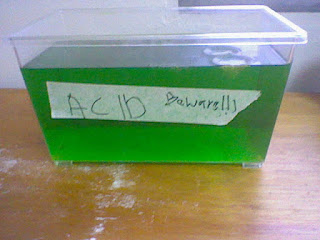
prepare acids, for etching,

schematic from arduino websites

now you etch it, before that you need a laser printer

after that based on schematics, solder it

now you get a arduino
Components RM55, Solder with own hand free. Having a hackable hardware, priceless
Subscribe to:
Posts (Atom)